
8 Before and After Ads Examples That Work
See 8 standout before and after ads examples, unpack what makes them effective, and learn how to adapt the tactics across platforms.
The most popular advice about before and after ads is to make the transformation as dramatic as possible. That’s the wrong starting point. A dramatic contrast can attract attention while leaving the important questions unanswered: What changed, what caused it, and can a customer reasonably expect something similar?
The right transformation makes the buying decision clearer, not just the image more striking. A brand can expose an unrealistic beauty standard, demonstrate a product result, or challenge a customer’s assumption. An operations team can use the same structure to evaluate a creative revision or budget decision, but those comparisons need different evidence.
The distinction matters because visual demonstration, customer experience, and incremental advertising impact aren’t interchangeable. Research on advertising impact measurement explains why observed conversions alone don’t establish what advertising caused. A polished transformation can illustrate an outcome without proving the product caused it or the campaign generated additional demand.
Before choosing an execution, decide what viewers should learn:
- A different perspective: Show why the starting assumption deserves reconsideration.
- A credible product result: Document the change and the conditions behind it.
- A better operating decision: Compare performance against a meaningful baseline or control.
The examples below are useful as strategic models, not guarantees of effectiveness. Adapt the mechanism, preserve the evidence, and resist copying the surface treatment when your product needs a different kind of proof.
Table of Contents
- 1. Dove ‘Evolution’ (2006)
- 2. Dove ‘Real Beauty Sketches’ (2013)
- 3. Crest 3D Whitestrips Before-and-After Demonstrations (Procter & Gamble)
- 4. Proactiv and Response-TV Before-and-After Testimonials (Guthy-Renker)
- 5. Creator-Led Before-and-After UGC on TikTok and Meta
- 6. Before-and-After Creative Split Testing in Paid Social and Search
- 7. Pre- and Post-Action Budget and Pause Optimization
- 8. FTC Endorsement Guides and Before-and-After Claim Substantiation
- 8-Point Before-and-After Advertising Comparison
- Build a Transformation People Can Trust
1. Dove ‘Evolution’ (2006)
The mechanism is a reveal about the image itself. Instead of presenting a polished appearance as the desirable endpoint, Dove’s Evolution offers a way to question how that endpoint was constructed. For a strategist, the useful distinction is between selling a transformation and exposing one.
This illustration captures that creative contrast without serving as evidence of a product result.

Adapt the reveal, not the beauty treatment
Consider an agency promoting an account audit. Instead of placing a distressed business owner beside a celebratory revenue chart, show the difference between a clean-looking summary report and the underlying account issues the team needs to investigate. The reveal becomes a reason to examine the system, not a promise of guaranteed growth.
That’s a proposed execution, not a reported case study. Its strength would depend on whether the agency can substantiate the problems it identifies and explain what its service changes.
Watch the supplied film with that distinction in mind.
Where it can fail: A provocative brand message can overshadow the offer. If viewers remember the critique but can’t identify the brand’s role, the creative team has made an argument without establishing a useful commercial connection.
Practical rule: Use the reveal to clarify a problem your brand can legitimately help address.
Keep the opening contrast concise, then connect it to a specific next step. Don’t turn criticism of misleading imagery into another unsupported transformation claim.
2. Dove ‘Real Beauty Sketches’ (2013)
Here, the transferable mechanism is a change in interpretation rather than a change in the subject. The self-description versus stranger-description structure associated with Real Beauty Sketches gives marketers a different creative question: Could the customer’s initial assessment be incomplete?
Treat that as a storytelling model, not a controlled demonstration that an audience’s perception will improve. A persuasive comparison of descriptions isn’t automatically objective evidence that one assessment is accurate.
For a performance marketer, a proposed adaptation might contrast what a business owner thinks is causing weak sales with what an account review reveals. The initial assumption could concern creative quality, while the review identifies a measurement problem requiring further investigation.
Make the correction observable
The useful sequence is assumption, examination, revised understanding. Show the information that justifies changing the initial view instead of asking viewers to accept the brand’s authority.
- Define the assumption: Name the belief the customer already holds without ridiculing it.
- Show the basis for revision: Use documented observations, not an unexplained expert verdict.
- Choose an appropriate outcome: Evaluate perception-led work differently from an immediate purchase offer.
A brand-lift study framework compares exposed audiences with a matched control group and can examine awareness, recall, favorability, consideration, or purchase intent. That makes it a more relevant measurement approach for a perception-focused concept than treating every response as a direct-sale opportunity.
Where it can fail: A marketer can frame a subjective comparison as if it proves a universal truth. Keep the conclusion proportionate to the evidence, and don’t substitute an emotionally satisfying reveal for a defensible measurement plan.
3. Crest 3D Whitestrips Before-and-After Demonstrations (Procter & Gamble)
Product-proof creative makes the outcome easier to inspect. For Crest 3D Whitestrips, the strategic model is a tooth-shade comparison tied to a defined product-use period. The adaptation lesson is to make the relevant change visible without allowing photography to manufacture it.
The supplied dental image illustrates a different intervention, veneers. It shouldn’t be presented as evidence of whitening-strip performance.
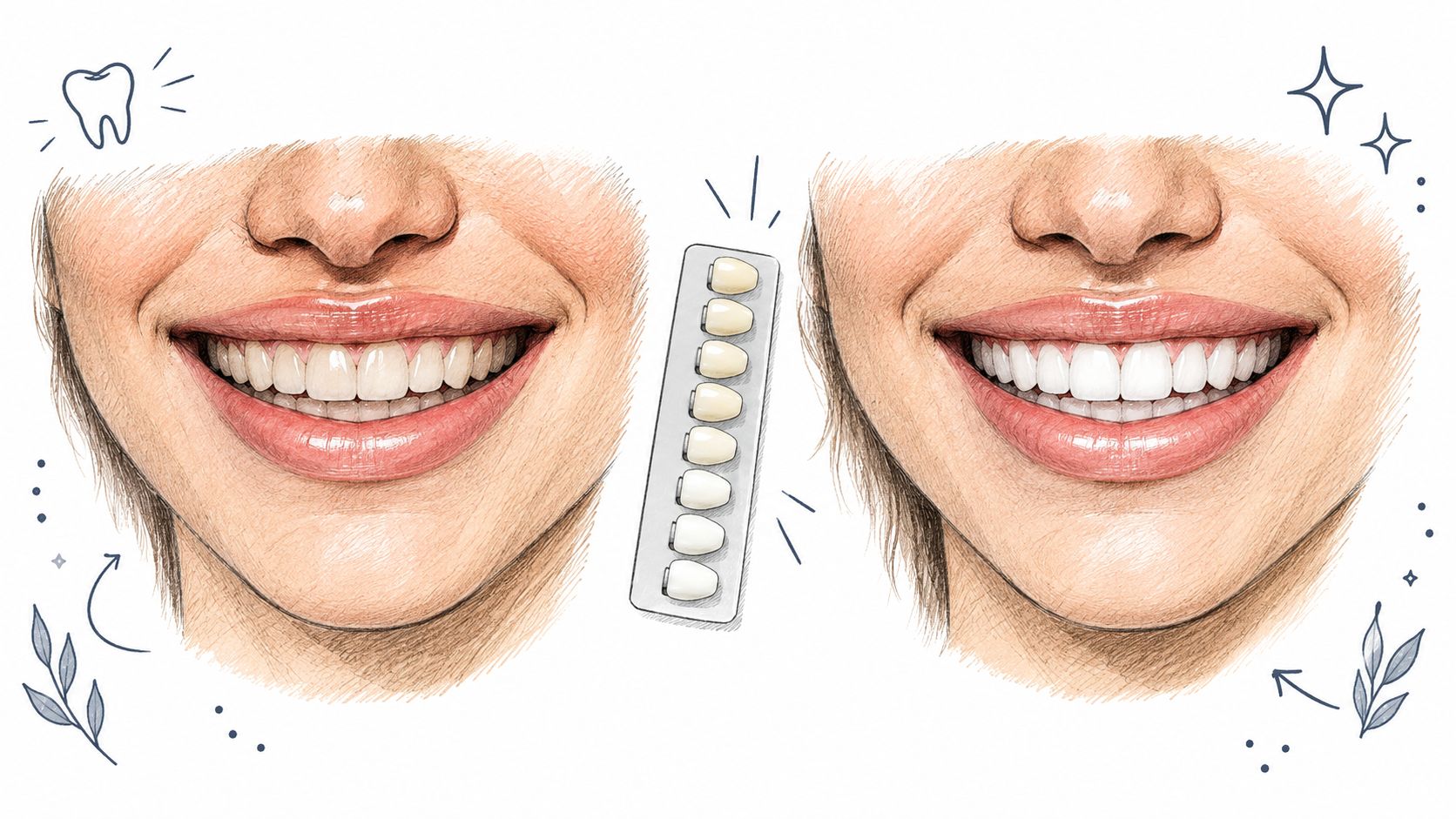
That mismatch exposes an important production risk: a visually relevant asset can still support the wrong claim. A smile comparison doesn’t establish which treatment produced the appearance, how long it took, or whether other procedures contributed.
Build the capture method before the ad
For a proposed product demonstration, brief the evidence collection alongside the creative:
- Match the conditions: Keep lighting, camera settings, framing, and subject positioning consistent.
- Record the process: Preserve the original files, product-use instructions, elapsed time, and relevant deviations.
- Limit the promise: Describe the measured change without extending it to unrelated benefits.
A useful adaptation outside dentistry might show the same surface before and after a cleaning product is applied under documented conditions. The comparison should isolate the product’s contribution rather than changing the surface, exposure, or finishing process.
Where it can fail: The advertiser standardizes the photograph but ignores the treatment. Identical lighting doesn’t make a comparison credible if the subject used additional products or received another intervention.
Test the demonstration against a product-in-use creative as well. The question isn’t whether the transformation looks impressive, but whether it improves a meaningful outcome without overstating what customers can expect.
4. Proactiv and Response-TV Before-and-After Testimonials (Guthy-Renker)
A testimonial adds a person’s experience to the visual comparison. The creative mechanism is identification: the viewer recognizes a problem, hears how someone approached it, and sees an outcome presented alongside that account.
Use Proactiv-style response advertising as a structural reference rather than a script to imitate. The useful components are a clearly described starting problem, an understandable routine, and a relevant next step. A customer’s delivery shouldn’t conceal missing information about how the result occurred.
For skincare, a documented sequence can provide more context than isolated endpoints. Content such as week-by-week mandelic acid progress can serve as a reference for organizing a timeline, but it shouldn’t be treated as substantiation for another product’s claims.
A customer story can explain an experience. It can’t, by itself, establish the result another customer should expect.
Keep the person and the proof separate
A proposed testimonial brief should ask what the customer used, what else changed, and what records support the timeline. Preserve their actual account rather than rewriting it into a more dramatic outcome.
Then separate the testing questions. Compare testimonial-led creative with product-led creative under comparable conditions, and judge qualified response rather than assuming a personal story deserves more budget.
Where it can fail: The advertiser selects an exceptional success and edits away the conditions that made it exceptional. Another failure is using a heartfelt story to imply product causation that the available evidence doesn’t establish.
The adaptation should preserve specificity without turning the participant into a universal example. If the evidence supports an experience claim but not a performance promise, write the ad around the experience.
5. Creator-Led Before-and-After UGC on TikTok and Meta
Creator-led transformation creative puts the demonstration inside a recognizable routine. A proposed closet-organization video, for example, can show the starting problem, the organizing process, and the finished space. The creator supplies context, but the visible process must still support the product’s role.
The supplied image illustrates that kind of reveal.

For a storage product, the most useful adaptation might explain which items the creator removed, which organizers they added, and what the customer would need to reproduce the arrangement. Otherwise, viewers may attribute the entire improvement to a product that contributed only part of it.
Give creators evidence boundaries
A brief should leave room for the creator’s voice while defining what they can demonstrate and claim. Review production and account-management options through a resource such as TikTok ads tools, then choose tools around the workflow rather than around the transition effect.
- Separate creative variables: Distinguish the creator, opening hook, starting problem, and demonstration.
- Preserve the record: Keep original footage, permissions, approvals, and the final ad version.
- Match results to versions: Record which creative launched and what changed before interpreting performance.
Where it can fail: The edit hides work, time, or purchases that materially contributed to the outcome. In the closet example, removing possessions and buying unrelated furniture could make the featured organizer look more consequential than it was.
Natural-looking footage isn’t a substitute for evidence. Adapt the creator’s way of explaining the problem, not an unsupported result or an artificial promise of effortless change.
6. Before-and-After Creative Split Testing in Paid Social and Search
In experimentation, the transformation is the marketer’s intervention. The question changes from whether the viewer can see a difference to whether the revised creative produces a different outcome under comparable conditions.
The distinction has a long operational history: Claude Hopkins used promotional coupons to compare responses, while randomized experimental design later strengthened the logic of treatment and comparison groups, as summarized in the history of split testing. The practical lesson is that a later result doesn’t become evidence of advertising impact just because an edit preceded it.
A proposed Meta test could compare an existing product demonstration with a version that makes the starting problem clearer. Keep the offer and destination consistent where feasible, so the result answers a useful creative question.
Separate a test from a retrospective
A concurrent comparison and a before-versus-after report aren’t equivalent. In a retrospective, changes in demand, audience composition, or measurement may coincide with the creative revision.
Use the guide to optimizing Facebook ads to organize the account workflow, and consult the Excellorix PPC management guide as a planning reference. Neither replaces a documented test design.
- Declare the hypothesis: Explain why the revised version should affect the chosen outcome.
- Define success before launch: Select the decision metric and evaluation conditions in advance.
- Record the intervention: Preserve the asset, settings, activation time, and any subsequent edits.
Where it can fail: A team changes creative, targeting, budget, and landing page together, then credits the new image. The package may perform differently, but the team can’t confidently identify which component mattered.
Launch proposed assets paused for review where the workflow permits. A test shouldn’t begin accidentally while someone is still checking the claim or destination.
7. Pre- and Post-Action Budget and Pause Optimization
A budget change creates a different kind of comparison: the variable is allocation, not the advertisement’s visual treatment. Before moving spend, write down the reason for the decision and the result that would justify keeping it.
A published e-commerce optimization case reported monthly spend moving from $20,000 to $28,000, attributed monthly revenue from $24,000 to $134,000, ROAS from 1.2x to 4.8x, and site-wide conversion rate from 0.8% to 2.5% after campaign rebuilding and landing-page relevance work. Those results describe a combined intervention, not proof that raising budgets alone produced the improvement.
That distinction changes the operational lesson. Evaluate spend, efficiency, and the conversion experience together rather than using revenue growth as automatic permission to scale.
Check measurement before crediting the action
Signal quality can also change the apparent outcome. In a Petrol Industries measurement case, server-side events and first-party data improvements accompanied doubled Meta ROAS, a 20% increase in Google Ads ROAS, and a 30% decline in Google Ads CPA.
Those changes shouldn’t be repackaged as evidence that a creative refresh worked. Record tracking interventions alongside budget and campaign edits so the team can distinguish the explanations.
For practical implementation, use an ad budget optimization workflow with explicit review conditions. AdCrunch can adjust Meta budgets and pause or resume entities while preserving action details in its permanent activity log.
Where it can fail: A buyer pauses an ad after an unrepresentative period or scales a temporary improvement. Matched review windows help, but they don’t eliminate seasonality or other concurrent changes.
Decision standard: An activity log establishes what the team changed. It doesn’t, by itself, prove what the change caused.
8. FTC Endorsement Guides and Before-and-After Claim Substantiation
A transformation image can communicate a claim even when the copy avoids making it explicitly. For a United States compliance review, the key question isn’t just whether the photograph is genuine. It’s whether the advertiser has adequate support for what viewers are being asked to conclude.
The FTC policy statement on advertising substantiation requires advertisers to possess a reasonable basis for objective claims before dissemination; later evidence generally doesn’t repair inadequate pre-launch substantiation. For relevant health and performance claims, competent and reliable scientific support may be necessary rather than testimonials alone.
Audit the claim beneath the picture
Separate the review into distinct questions:
- Visual authenticity: Were the files altered, and were the capture conditions comparable?
- Causation: What supports attributing the change to the advertised product?
- Representativeness: Does the featured outcome reflect what customers can reasonably expect?
- Scope: Does the evidence support the whole implied promise, including duration and degree?
Consider a proposed skincare testimonial featuring an unusually strong result. Customer permission and original photographs address authenticity and consent, but they don’t establish causation or typicality.
Where it can fail: The team treats a disclaimer as a replacement for evidence, or approves the image without reviewing the headline, narration, and landing page together. Another risk is assuming legal review automatically establishes platform eligibility.
Keep treatment details, timestamps, exclusions, relevant outcomes, permissions, and approval records together. Review paid relationships and disclosure needs as part of the same process, and seek qualified legal advice for the specific claim and market.
The strategic trade-off is straightforward: a less dramatic comparison with defensible support may be a better asset than a spectacular result the team can’t explain.
8-Point Before-and-After Advertising Comparison
| Example | 🔄 Implementation complexity & resources | 📊 Expected outcome | ⭐ Key advantage | 💡 Ideal use case | ⚡ Main constraint |
|---|---|---|---|---|---|
| Dove “Evolution” (2006) | Medium; video production, editing, brand strategy | Awareness and discussion of how advertising imagery is constructed | Memorable visual reveal with a clear brand position | Brand storytelling around transparency or cultural issues | Limited direct sales attribution; message needs consistent brand action |
| Dove “Real Beauty Sketches” (2013) | High; participant casting, filming, editing, social distribution | Emotional engagement, sharing, and potential brand lift | Human insight communicated through a clear comparison | Campaigns built around identity, perception, or self-esteem | Sensitive subject matter; direct ROI is difficult to measure |
| Crest 3D Whitestrips demonstrations | Medium–high; controlled photography and claim substantiation | Visible product results linked to purchase intent | Concrete, product-specific visual proof | Products with measurable changes over a defined treatment period | Results and imagery require consistent conditions and substantiation |
| Proactiv and response-TV testimonials | Medium–high; customer stories, offers, tracking, compliance review | Measurable inquiries or purchases through direct-response channels | Combines visible outcomes, testimonials, and a direct call to action | Products with demonstrable results and trackable offers | Atypical-result claims can create trust and regulatory risks |
| Creator-led before-and-after UGC on TikTok and Meta | Medium; creator sourcing, multiple edits, partnership ad setup | Feed engagement and rapid creative testing | Native-feeling content can generate multiple testable variants | Beauty, home, fitness, and e-commerce campaigns | Results vary by creator; disclosures and frequent refreshes are needed |
| Before-and-after creative split testing in paid social and search | Medium–high; testing setup, analytics, and change logs | Comparative performance data, such as CPA or ROAS | Helps identify which creative or account change affected results | Teams optimizing ads across platforms or accounts | Seasonality, learning effects, and low sample sizes can distort findings |
| Pre- and post-action budget and pause optimization | Medium; account monitoring, thresholds, and activity tracking | Changes in cost efficiency and wasted spend after interventions | Makes operational changes measurable | Teams managing multiple campaigns or accounts with frequent spend decisions | Premature pauses or delayed action can reduce performance |
| FTC endorsement guides and claim substantiation | High; evidence collection, disclosures, and legal or compliance review | More credible claims and reduced legal and reputational exposure | Establishes a compliance baseline for testimonials and transformation claims | Any U.S. campaign using endorsements or before-and-after claims | Requirements vary by jurisdiction; evidence and review require resources |
Build a Transformation People Can Trust
The strongest before and after ads make the starting problem specific, the transformation understandable, and the next step proportionate to the evidence. They don’t ask an attractive ending to carry every part of the argument.
Start by naming the job the creative must do. A brand story may challenge an assumption; a product demonstration may make a functional difference inspectable; a testimonial may explain a customer’s experience. An operational comparison has another job entirely: helping a team decide whether to retain, reverse, or investigate an intervention.
Write the evidence brief with the creative brief
Before production, state what the audience should conclude and what supports that conclusion. If the proposed ad implies more than the evidence establishes, change the execution before investing in its polish.
A useful brief should distinguish:
- What viewers will see: The starting state, process, and outcome.
- What the advertiser can support: The documented change and its relevant conditions.
- What remains uncertain: Causation, representativeness, persistence, or applicability to another customer.
- What action is appropriate: Learn more, inspect the evidence, request an assessment, or purchase with accurate expectations.
When you browse real customer results, assess the accompanying context rather than the visual contrast alone. Ask whether the page explains enough about the process to help a prospective customer interpret the outcome, without treating another brand’s presentation as proof for your own claims.
Keep production and measurement records connected. Preserve original assets and approvals, then record when each version launched, what changed, and which outcome the team used to evaluate it.
Scale the supported conclusion
For creative testing, isolate the variable wherever feasible and define the decision rule before reviewing results. For budget changes, account for other interventions and measurement changes rather than assuming that everything after the action resulted from it.
Don’t confuse restraint with weak creative. A clear demonstration can still be compelling when it shows the actual process, acknowledges meaningful conditions, and avoids implying a guaranteed outcome.
The practical goal isn’t to produce the biggest possible contrast. It’s to create a comparison the customer can understand and the advertiser can defend, then invest in versions that produce measurable value under an appropriate evaluation method.
AdCrunch connects performance data across Meta, TikTok, and Google Ads, and lets teams direct supported campaign, budget, and pause actions on Meta with a permanent activity log. Visit AdCrunch to connect your accounts and keep before-and-after decisions tied to the changes your team made.